
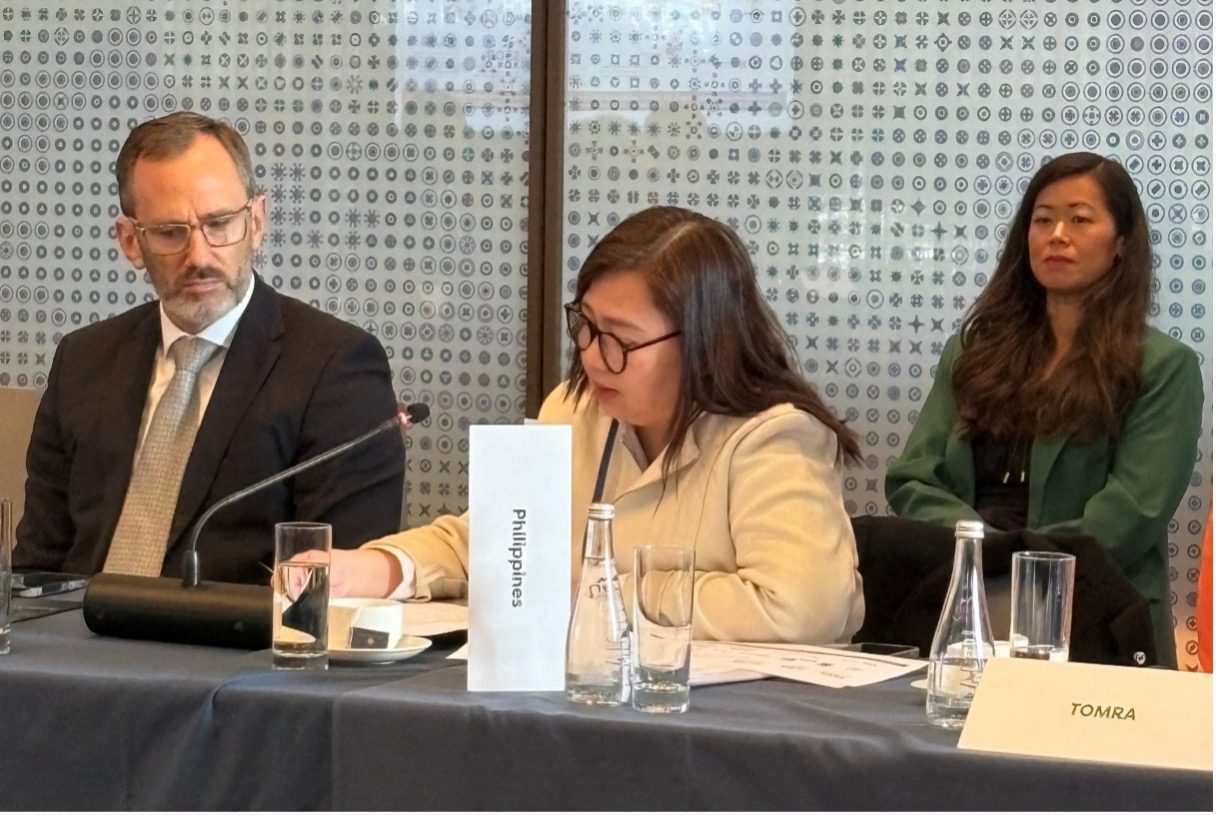






Department of Environment and Natural Resources (DENR) Undersecretary for Finance, Information Systems, Climate Change and Administration Atty. Analiza Rebuelta-Teh, speaks during the High-Level Business and Policy Roundtable on the Global Plastics Treaty on September 23 at Apella at Riverpark in New York City. Teh urged negotiators to establish binding global rules to curb plastic production, strengthen corporate accountability, and align public and private investment with circular economy goals.
Emphasizing that the global plastic crisis is inextricably linked to climate change, the Department of Environment and Natural Resources (DENR) called for a predictable and standardized framework under a future Global Plastics Treaty to help align global capital with circular outcomes.
Atty. Analiza Rebuelta-Teh, Department of Environment and Natural Resources (DENR) Undersecretary for Finance, Information Systems, Climate Change and Administration, spoke at the High-Level Business and Policy Roundtable on the Global Plastics Treaty held on September 23 at Apella at Riverpark in New York City. She stressed that a highly fragmented regulatory landscape remains a primary barrier to scaling circular solutions and called for harmonized global standards to provide greater predictability for public and private investment.
“We cannot solve the climate crisis without solving the plastic crisis. A future Global Plastics Treaty would be the most critical environmental deal since the 2015 Paris Agreement,” Undersecretary Teh said during the high-level dialogue.
Undersecretary Teh stressed that harmonized global policies serve as a foundational derisking mechanism for both public and private capital. She pointed out that standardized Extended Producer Responsibility metrics and unified regulatory definitions reduce cross-border compliance costs, giving institutional investors and multilateral development banks the policy predictability required to deploy large-scale capital into sustainable infrastructure and bankable public-private partnerships.
“To achieve our 2040 goal of ending plastic pollution, the final treaty must establish a predictable, standardized framework that aligns global capital with circular outcomes,” Undersecretary Teh stated, emphasizing that voluntary national targets create fragmented, sub-scale markets rather than the aggregate demand needed for circular materials.
Addressing the severe economic challenges facing developing economies and Small Island Developing States, Undersecretary Teh warned that uniform downstream mandates imposed without robust, legally binding financial assistance mechanisms would result in widespread implementation failure. She urged the private sector to transition from passive compliance to active partnership by sharing open-source data on alternative material scaling, championing mandatory criteria to clear out market distortions caused by artificially cheap virgin plastics, and co-investing directly in regional waste infrastructure.
Crucially, Undersecretary Teh cautioned international negotiators against crafting an agreement focused solely on downstream waste management and recycling, insisting that genuine economic viability requires legally binding global restrictions on raw polymer production and hazardous additives.
“A weak treaty is one that focuses only on waste management and recycling. This will lock countries into a permanent cycle of toxic exposure and waste management expenses it cannot afford,” Undersecretary Teh emphasized. “A strong treaty enforces the Nice Call declaration to cut production globally and shifting the fiscal burden of cleanup onto the multi-national corporations that manufacture the plastic.”
The high-level roundtable, held consistent with United Nations Environment Assembly Resolution 5/14, sought to align government priorities with business interests ahead of final treaty deliberations. As global negotiations reach a decisive stage, Undersecretary Teh reaffirmed the commitment of the Philippines to advocating for binding baseline rules that hold plastic manufacturers accountable while delivering economic and technical support to developing nations.