
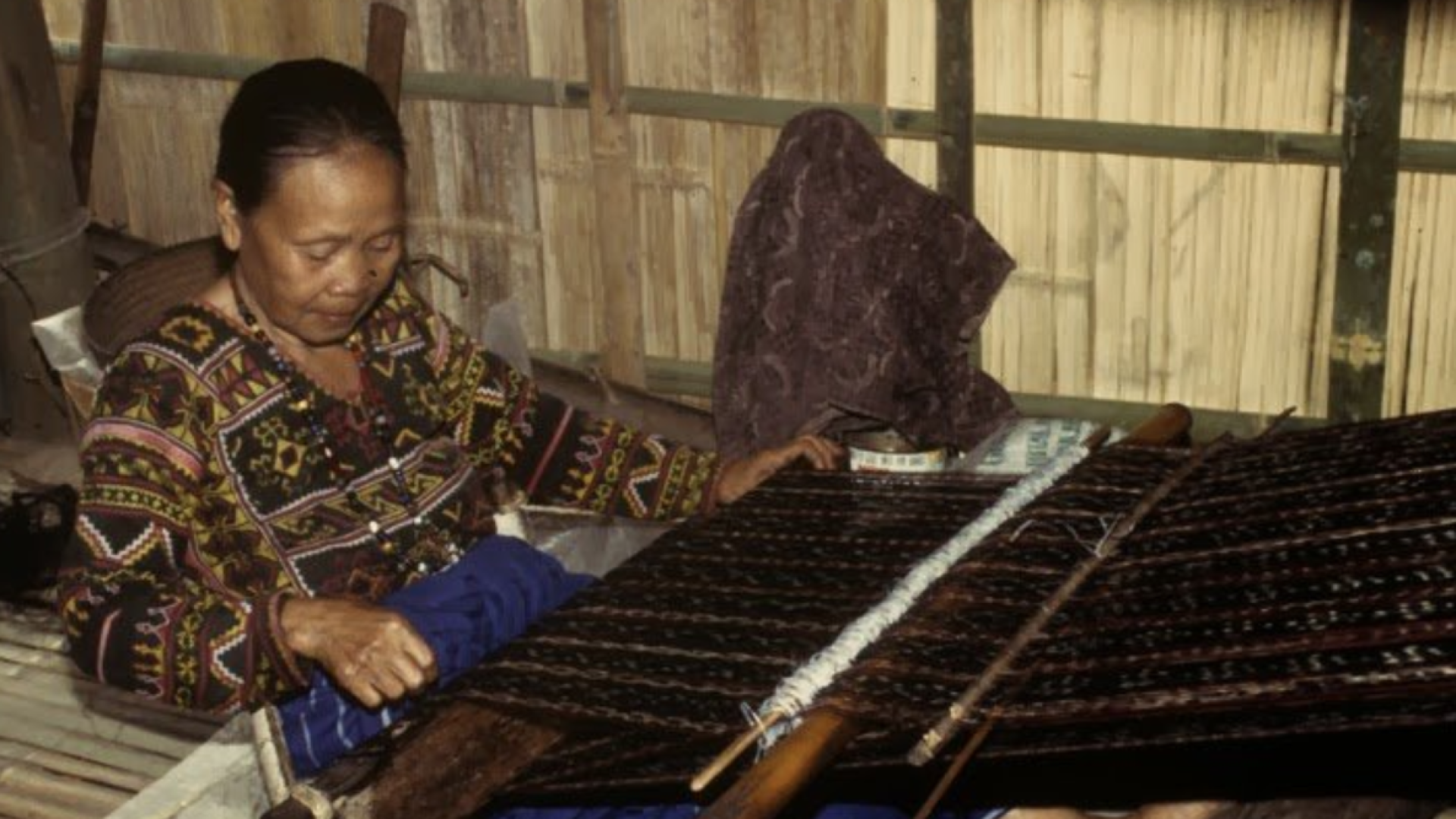






This National Heritage Month, the CCP Encyclopedia of Philippine Art (CCP EPA) highlights seven Filipina culture bearers and traditional craft artists whose historic contributions preserve the country’s rich cultural legacy. These exemplary individuals, who translate inherited knowledge and generational memories into art, have been awarded the Gawad sa Manlilikha ng Bayan (GAMABA), the highest Philippine state honor for traditional folk artists.
Learn how they navigate the delicate intersection of tradition and modernity through the CCP EPA, the invaluable record of the Philippines’ artistic and cultural practices.
LANG DULAY
Lang Dulay, awarded the GAMABA in 1998, was instrumental in preserving and promoting t’nalak, the sacred textile of the T’boli people of South Cotabato. Her work was celebrated for its exceptional craftsmanship, noted for the fineness of the fibers, the tightness of the weave, and the precision of its traditional forms and patterns. A master weaver from Lake Sebu, she trained 46 weavers in her community until her retirement in 2011, ensuring the continuity of the craft before her passing in 2015. She remained steadfast against the commercialization of t’nalak, creating traditional weaves and mastering designs inspired directly by her natural surroundings, such as bulinglangit (clouds), kabangi (butterflies), and other motifs found in the mountains and streams.
MAGDALENA GAMAYO
Magdalena Gamayo, fondly known as ‘Lola Dalen’, is a master weaver of inabel, the traditional Ilocano textile from the Ilocos region. Even at 102 years old, she remains dedicated to preserving this handwoven fabric, a mission she undertook after learning the craft from her aunt. Awarded the GAMABA in 2012, she is celebrated for her exceptional mastery in producing intricate designs, including binakol, inuritan (geometric designs), kusikos (spiral forms), and sina-sabong (flower patterns), and for inventing her own unique patterns of abel Iloco. Her dedication to keeping the traditional weaving industry alive earned her the title “Grandmother of Abel Iloko” in 2014 from the National Museum of the Philippines.
HAJA AMINA APPI
Haja Amina Appi, a highly regarded Sama mat weaver from Tawi-Tawi, was recognized with the GAMABA award in 2004 for her exceptional mastery. Combining traditional techniques with innovative designs, she was known for weaving complex geometric patterns, often utilizing up to eight vibrant colors in a single piece. She ensured the preservation of this tradition by diligently passing her specialized skills to her daughters and granddaughters before her passing in 2013.
AMBALANG AUSALIN
Apuh Ambalang Ausalin is a master Yakan textile weaver from Basilan, celebrated for her mastery of intricate diamond patterns and vibrant color palettes. Her work prominently featured the sinaluan, a complex twill-woven cloth, and Bunga Sama textiles decorated with precise rhombus motifs.
Through iconic designs such as peneh kenna-kenna (fish), peneh sawe-sawe (snake), and peneh kule-kule (turtle), Ausalin’s artistry reflected the deep spiritual connection between her community and the natural world. In 2016, her lifelong dedication to preserving Yakan culture was honored with the GAMABA award.
ESTELITA BANTILAN
Estelita Bantilan of Sarangani is renowned for her vibrant and intricate igēm, the B’laan mats masterfully handwoven from the long leaves of thornless romblon pandan. Her exceptional artistry, characterized by a sophisticated color sensibility and the use of natural dyes, distinguishes her work as a hallmark of traditional craftsmanship. Recognized with the GAMABA award in 2016, Bantilan remains a steadfast guardian of her heritage, dedicating her life to ensuring the B’laan mat weaving tradition endures for future generations.
YABING MASALON DULO
With her talent closely tied to her spiritual beliefs, South Cotabato’s Yabing Masalon Dulo would perform rituals before weaving to seek blessings from the spirits. Besides becoming a master weaver, she blossomed into a dyer, bead-maker, and embroiderer.
Dulo was renowned for her mastery of mabal tabih, a traditional Blaan textile made from abaca, using the ikat (tie-dye resist) technique. Before her passing, she taught weaving to younger generations. She was awarded the GAMABA in 2016.
ABINA COGUIT
Recognized as a matugo manunuyam (virtuoso embroiderer), Abina Coguit has mastered suyam, the traditional embroidery of Agusanon Manobo. After inheriting her grandmother’s knowledge at age 15, she often depicted elements of nature, such as the binuaja (crocodile) and binaksan (snake).
Coguit is said to be blessed and chosen by the spirit Tuma to become a master of her craft. She is the first Manobo awardee from Agusan Del Sur to receive her GAMABA in 2023.
The CCP EPA: A Priceless Record of Philippine Arts and Culture
Through the masterful work of Dulay, Gamayo, Appi, Ausalin, Bantilan, Dulo, and Coguit—spanning weaving, mat-making, and embroidery—we witness tradition flourishing into a vital way of remembering and reinterpreting cultural heritage. This irreplaceable body of work is meticulously documented in the CCP Encyclopedia on Philippine Art (EPA), the country’s most comprehensive resource on arts and culture.
Featuring contributions from over 500 renowned scholars and experts, the CCP EPA serves as a priceless record of Filipino creative and artistic practices.
Subscribe to the CCP EPA for as low as Php99 per month or Php999 per year. Check out the official website at epa.culturalcenter.gov.ph/encylopedia. Email epa@culturalcenter.gov.ph to purchase a copy of the CCP EPA print edition and/or the special USB offline version.